"The value of one lot, instead of dividing it across two homes, you're dividing it across three."
That's how Jenna Edge, president of Ash Creek Homes, described the arithmetic behind Austin's HOME ordinance to a local building trade outlet last fall. Since the city adopted HOME Phase 1 in December 2023 and Phase 2 in May 2024, that arithmetic has become the default way to think about an Austin teardown. Buy one lot, put up to three units on it, and the land cost that used to sit under a single house now gets spread across three closings.
It's a useful way to think about most of Austin. It does not describe Barton Hills.
Much of Barton Hills sits inside what the city calls the Barton Springs Zone, the watershed area governed by the 1992 Save Our Springs Ordinance. That ordinance caps impervious cover, meaning the combined footprint of a house, driveway, patio, and walkways, at 15 percent of net site area in the most restricted parts of the zone. The cap applies to the parcel. It does not care whether one household lives there or three.
What a Percentage Actually Buys
Run the number on a full acre, 43,560 square feet. At 15 percent, that's 6,534 square feet of total hardscape to work with, house included. Compare that to a standard SF-1 lot outside the environmental overlay, where the city's 2024 HOME amendments set impervious cover at 45 percent. The same acre outside the Barton Springs Zone allows 19,602 square feet of coverage, roughly three times as much.
That gap doesn't shrink if you add units. A three-unit HOME project on a Barton Springs Zone lot still answers to the 15 percent ceiling. The extra units don't create extra footprint to build on. They just divide a smaller pie into more pieces.
| Barton Springs Zone (SOS Ordinance) | Standard SF-1 post-HOME | |
|---|---|---|
| Impervious cover cap | 15% of net site area (up to 20-25% in some sub-areas) | 45% |
| Applies per lot or per unit | Per lot, regardless of unit count | Per lot, but divisible across up to three units |
| Governing rule | Land Development Code Ch. 25-8, adopted 1992 | HOME Phase 1 (Dec. 2023) and Phase 2 (May 2024) |
City figures released in May 2026 show how differently that math has played out across Austin. More than 600 applications under HOME Phase 1 had been approved as of that month, adding over 1,200 housing units citywide. Phase 2, which lowered the minimum lot size to 1,800 square feet, moved slower: about 40 small-lot buildings and half a dozen subdivisions were in progress by that spring. Barton Hills isn't broken out separately in that data, but the mechanism explains why a neighborhood built almost entirely inside the Barton Springs Zone wouldn't show up as a hot spot for HOME conversions even as other parts of the city do.
The Other Rule Still Standing
Barton Hills carries a second layer that matters just as much. Subchapter F, better known as the McMansion Ordinance, was adopted in 2006 to slow the pace of teardowns replacing older homes with oversized new construction. It capped floor-to-area ratio at 0.4 and added a tent-shaped height envelope that narrows as a house rises above the second floor. The Austin Chronicle's reporting on the ordinance put its actual track record bluntly: it "has primarily induced the construction of large homes that still conform to the limits set out in the ordinance."
HOME changed who Subchapter F applies to. Under Phase 1, the McMansion rules now govern only single-unit dwellings. A duplex or three-unit project on the same lot is instead reviewed under separate standards that allow a floor-to-area ratio as high as 55 to 65 percent, well above the single-family cap.
On paper, that's a big advantage for multi-unit construction. In practice, inside the Barton Springs Zone, the impervious cover ceiling still governs the footprint no matter which FAR rule applies to the building above it. A homeowner rebuilding a single house on a Barton Hills lot answers to the tighter of two ceilings, the McMansion FAR cap. A developer converting the same lot to three units escapes that FAR cap but still can't push the footprint past 15 percent. Neither path gets around the number that actually constrains the site.
How Strict the Cap Really Is
The strength of the 15 percent rule isn't theoretical, and it shows up in the neighborhood's own case file. A 2023 city ordinance amendment request covered two lots and a tract at Airole Way in Barton Hills, a combined 0.55 acres, roughly 24,023 square feet. Under the standard SOS math, that site would be capped at about 2,348 square feet of total impervious cover, not nearly enough to renovate an existing historic residence and add a second home on the adjacent undeveloped lot, which is what the owners wanted to do. To make the project work, they had to file for a site-specific amendment to the Save Our Springs Initiative itself, requesting coverage up to 34.7 percent of gross site area, with a public hearing calendared for February 2024.
That's the process an ordinary Barton Hills lot goes through when the math doesn't pencil at 15 percent. Not a routine permit review, but a formal amendment to a voter-approved ordinance, filed lot by lot.
What This Looks Like on a Barton Hills Street
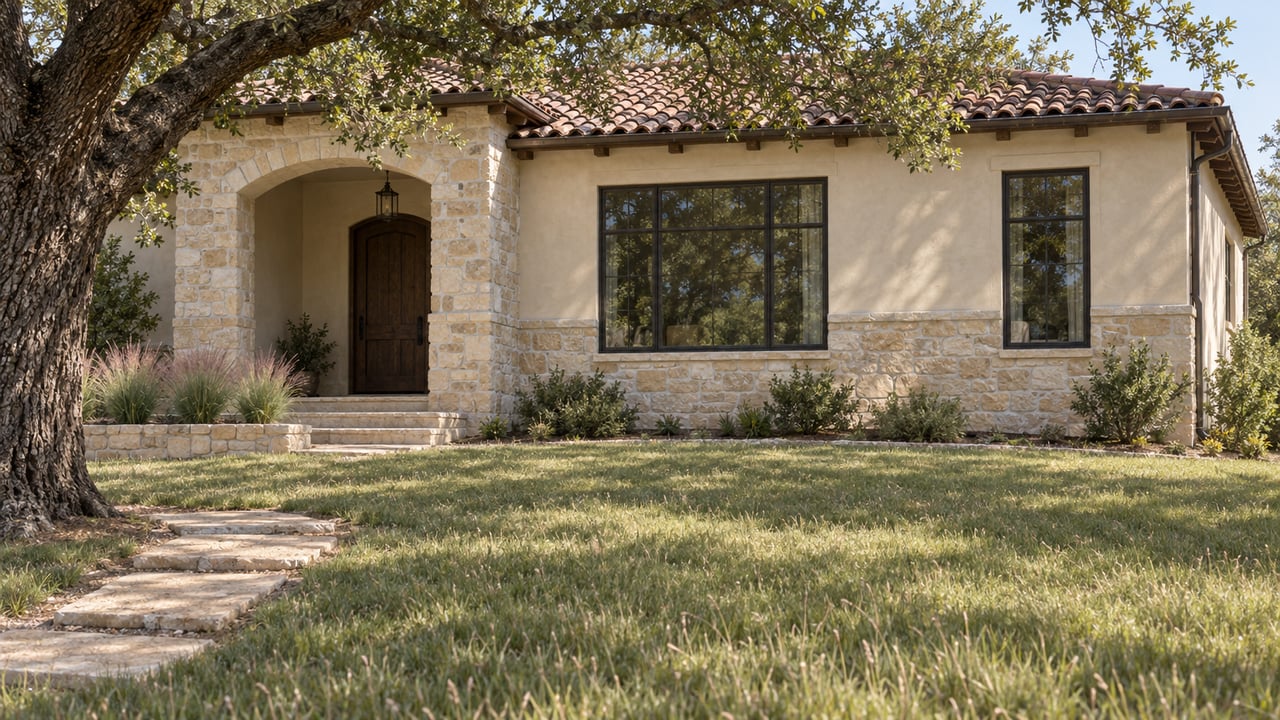
Most of the neighborhood's housing stock dates to the 1940s through the 1960s, mid-century ranch homes on lots that read as generous by central Austin standards. Barton Hills carries no mandatory homeowners association, which usually reads as more design freedom. The Barton Springs Zone and the city's tree protections do more to shape what gets built here than any HOA architectural committee would.
Austin's heritage tree rules add a third constraint worth naming alongside impervious cover and FAR. Trees 24 inches or larger in diameter can't be removed without a variance from the city's Land Use Commission, and removal requires replacement at a 3-to-1 ratio. Barton Hills' tree canopy, part of what gives the neighborhood its character along the Barton Creek Greenbelt and near Zilker Park, is also part of what a builder has to design around before touching the impervious cover math at all.
City leaders are actively revisiting HOME itself. In May 2026, Council Member Krista Laine sponsored a resolution to simplify parts of the ordinance after builders and residents flagged confusing reviews and added construction costs. "HOME is working," she told Council, while pushing for changes to lot width rules and subdivision procedures. That resolution passed 9-1. None of it touches the Save Our Springs Ordinance, which was adopted by voter initiative and sits in a different part of the code entirely. Austin's density rules are still moving. The 15 percent line in Barton Hills has not.
Before You Assume a Lot Pencils
A few checks are worth doing before treating any Barton Hills parcel as a straightforward rebuild or multi-unit opportunity.
- Confirm whether the specific parcel sits inside the Barton Springs Zone and, if so, which sub-area, since the cap ranges from 15 to 25 percent depending on location within the zone. Not every Barton Hills lot carries the same number.
- Check the base zoning. Most of the neighborhood is SF-3, with some SF-2, and each carries its own setback and lot area rules layered under the SOS cap.
- Ask whether the lot was platted before 1991. The Land Development Code carries a narrow exception for lots platted before that year, ahead of the Save Our Springs Ordinance taking effect in August 1992, where renovations to residential structures under 8,000 square feet may qualify for different treatment.
- Get a tree survey early. Heritage and protected trees can eliminate buildable area before impervious cover even enters the conversation.
- Talk to the Barton Hills Neighborhood Association if a project involves any change of use. It won't change the ordinance, but it will tell you how a specific block has handled similar projects before.
A Few Direct Questions
Does the Barton Springs Zone cover all of Barton Hills? No. The zone follows watershed boundaries, not neighborhood lines, so coverage varies parcel by parcel. Checking the specific lot matters more than assuming based on the neighborhood name.
Does HOME help at all if a lot sits inside the zone? It can still permit more units on paper. The practical benefit is smaller than in a non-SOS lot, because the impervious cover cap governs the physical footprint regardless of how many units sit on it.
Is the 15 percent cap likely to change? It was adopted by voter initiative in 1992. Getting past it on a single lot, as the Airole Way filing shows, means a site-specific ordinance amendment and a public hearing, not a form at a permit counter. That's a higher bar than most zoning changes in the city clear.
If you're weighing a Barton Hills purchase against its buildable potential, or trying to figure out what a specific lot's zone status actually allows before you write an offer, The Weiss Group can help you get the parcel-level answers before you're under contract, not after.